


Published by The Morton Group with AtCoastal Realty | Todd Morton, REALTOR and Owner | October 19, 2026
The practical answer: A seller credit used for a permanent mortgage-rate buydown can sometimes reduce a buyer's monthly payment more than an equal price reduction, while a closing-cost credit may help more when cash at settlement is the bigger concern. A temporary buydown only reduces the buyer's principal-and-interest payment for an initial period. The right choice depends on the lender's actual pricing, the loan program, the buyer's timeline and the home's appraisal.
With Freddie Mac's national 30-year fixed mortgage average at 7.40% on October 15, 2026, Hampton Roads buyers should compare concessions by their effect on payment, cash to close and total borrowing cost - not by the headline dollar amount alone.
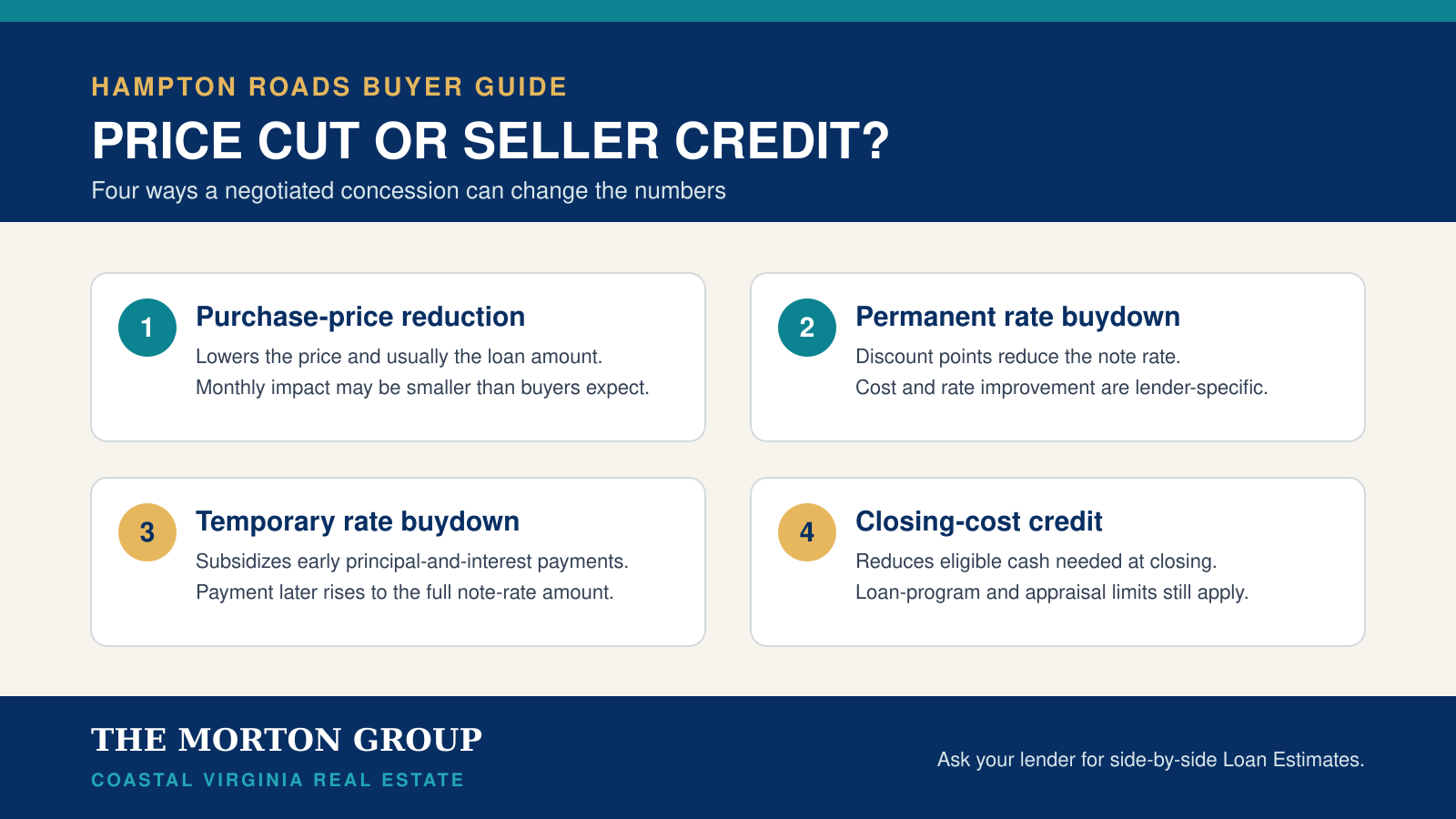
What changes with each type of concession?
| Option | Primary effect | Question to ask |
|---|---|---|
| Price reduction | Lowers the price and usually the loan amount | How much does this actually change my payment? |
| Permanent buydown | Pays discount points for a lower note rate | What is the break-even period? |
| Temporary buydown | Subsidizes early principal-and-interest payments | Can I comfortably afford the full payment later? |
| Closing-cost credit | Reduces eligible cash due at settlement | Which costs can the credit cover? |
When does a price reduction make sense?
A lower price reduces the amount paid for the property and may lower the loan balance, down payment and principal-and-interest payment. It can also help when the agreed price needs to align with an appraisal. However, spreading a modest price reduction across a 30-year loan may produce a smaller monthly-payment change than buyers expect.
A price cut may be more attractive to a buyer who values lower debt, plans to pay cash, or cannot use all of an available seller credit. It also avoids paying for a financing feature that may lose value if the buyer sells or refinances sooner than expected.
How does a permanent rate buydown work?
A permanent buydown uses discount points to obtain a lower interest rate. The Consumer Financial Protection Bureau explains that one point equals 1% of the loan amount, but the rate reduction received for a point is not fixed. It varies by lender, loan type and market conditions.
This option can be useful when payment is the priority and the buyer expects to keep the mortgage long enough to recover the upfront cost. Ask the lender to calculate the break-even period and compare the same loan with zero points.
What is different about a temporary buydown?
A temporary buydown does not permanently change the mortgage's note rate. Instead, deposited funds subsidize part of the scheduled principal-and-interest payment during the opening years. The payment then steps up according to the written plan until the buyer pays the full note-rate amount.
Fannie Mae and Freddie Mac guidelines generally require qualifying eligible fixed-rate borrowers using the full note-rate payment, not the temporary reduced payment. That is an important guardrail, but buyers still need a realistic budget for the later payment. Eligibility and structure depend on the loan program and lender.
When is a closing-cost credit more useful?
A seller credit toward eligible closing costs can preserve cash for moving, repairs or reserves. The CFPB's Loan Estimate guide shows seller credits in the cash-to-close calculation. Credits cannot simply become cash back, and allowable amounts depend on loan-program rules, actual eligible costs and appraisal support. Confirm the usable amount with the lender before writing it into an offer.
How should Hampton Roads buyers compare the options?
Ask the lender for side-by-side Loan Estimates prepared on the same day with the same loan type, down payment and lock assumptions. Compare:
- Cash needed at closing
- Full monthly payment, including taxes, insurance and mortgage insurance
- Payment after any temporary buydown ends
- Interest and fees over the period you realistically expect to keep the loan
- Whether unused credits, appraisal limits or program rules change the deal
The CFPB recommends comparing Loan Estimates and reviewing the five-year cost of borrowing rather than focusing only on the advertised rate. For broader local context, see our Hampton Roads real estate market report.
Local takeaway: The most valuable concession is the one that solves the buyer's actual constraint without creating an uncomfortable future payment. Coordinate the offer language with your agent and lender before ratification, because a credit that looks attractive on paper may not be fully usable under the final loan structure.
Contact The Morton Group to discuss a property-specific offer strategy. Mortgage terms should be confirmed with a licensed lender; this article is educational and is not lending or financial advice.
Sources
- Freddie Mac Primary Mortgage Market Survey (October 15, 2026)
- CFPB: Discount points and lender credits (accessed October 19, 2026)
- CFPB: Compare and negotiate Loan Estimates (accessed October 19, 2026)
- Fannie Mae: Temporary interest rate buydowns (policy dated August 7, 2024; accessed October 19, 2026)
- Freddie Mac: Temporary subsidy buydown plans (accessed October 19, 2026)