


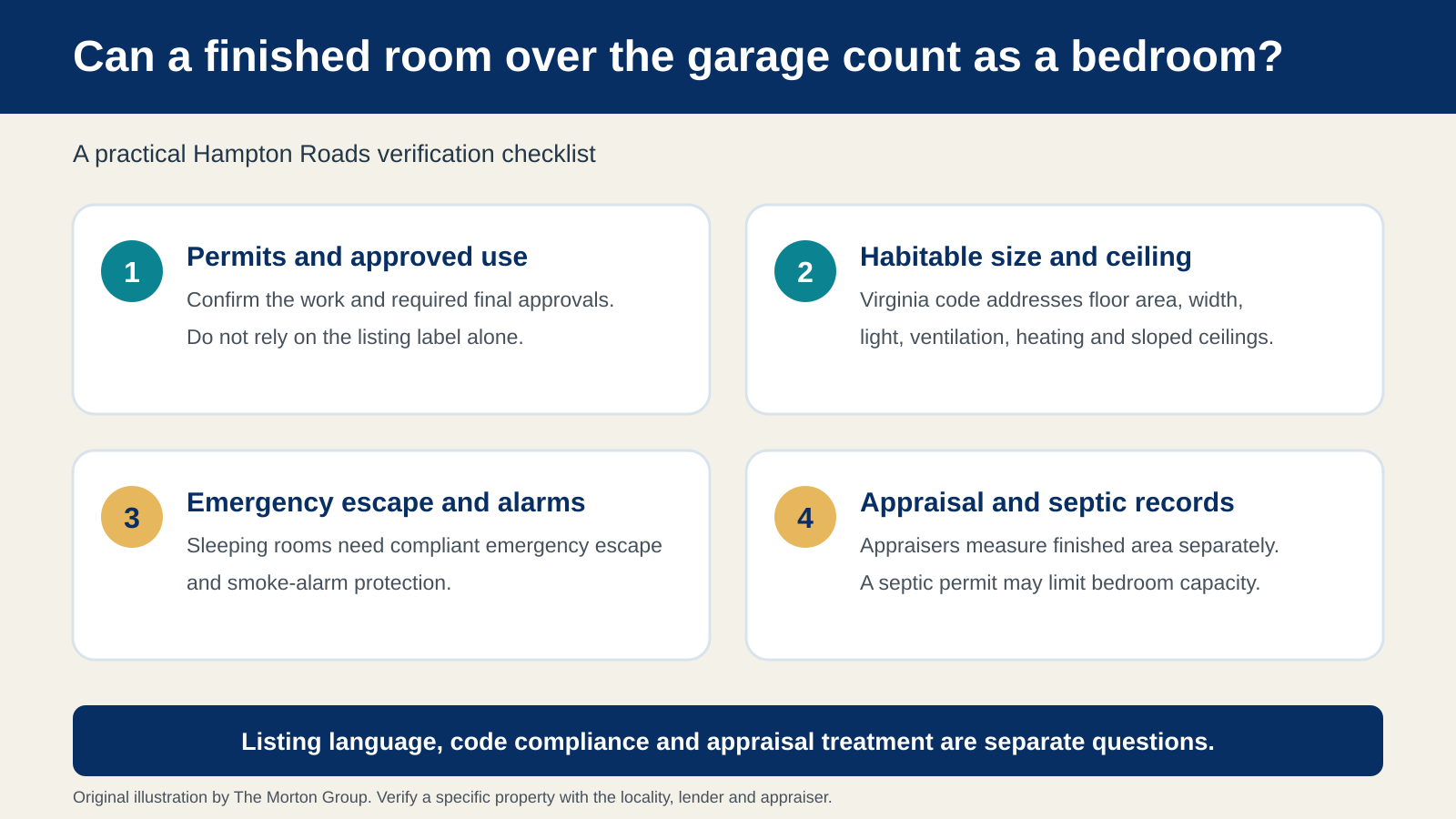
The practical takeaway: a finished room over the garage can sometimes be marketed and appraised as a bedroom, but the words "finished room" or "FROG" do not settle the question. Verify the approved use, room features, emergency escape, appraisal treatment and any septic-bedroom limit before counting it.
A closet, private bathroom or Jack-and-Jill bathroom may make the space more useful, but none of those features alone proves that it is a compliant bedroom.
Published by The Morton Group with AtCoastal Realty | Todd Morton, REALTOR and Owner | November 16, 2026
What makes a room suitable for sleeping under Virginia code?
The 2021 Virginia Residential Code, effective January 18, 2024, addresses habitable rooms and sleeping rooms through several separate requirements. Among them, a habitable room generally needs at least 70 square feet of floor area and a horizontal dimension of at least 7 feet.
Ceiling height matters in the sloped spaces common above garages. Habitable space generally needs a 7-foot ceiling. For a room with a sloped ceiling, the required floor area must have a ceiling at least 5 feet high, and at least half of that required area must be 7 feet high. Portions below the applicable height do not count toward the minimum area.
The code also addresses light, ventilation and heating. A room can look finished while still leaving unanswered questions about whether it was approved as habitable or sleeping space.
Does the window qualify as emergency escape?
Every sleeping room designated on construction documents generally needs an operable emergency escape and rescue opening unless a code exception applies. The code specifies a minimum clear opening, minimum width and height, and a maximum opening height above the floor. It also requires smoke alarms inside each sleeping room and outside sleeping areas.
Do not measure the glass and guess. Window sash operation, clear opening and sprinkler exceptions can affect the answer. Ask the local building department or a qualified inspector to evaluate the specific room.
Do permits and final approvals matter?
Yes. A room may have been built as part of the original house, finished later with permits, or converted without the required approval. Those are different situations. Request permit records, approved plans and final inspections from Virginia Beach, Chesapeake, Norfolk, Portsmouth, Suffolk or the applicable locality.
If the room was added or converted, compare the current layout with public records and the seller's documentation. Our guide to checking renovation permits and final approvals explains why a permit number alone may not show that every required inspection was completed.
Will an appraiser count the room and square footage?
Appraisal reporting is a separate question from the listing description. Fannie Mae requires appraisers to apply the ANSI Z765-2021 measurement standard for applicable one-unit properties. Finished above-grade area, nonstandard finished area and room counts must be reported consistently.
A room above an attached garage may contribute to finished area and value when it meets the applicable measurement and access standards. If ceiling height or access does not conform, the appraiser may report the space separately. An agent should not promise in advance how a lender's appraiser will classify or value it.
What if the property has a septic system?
Bedroom count can also affect onsite sewage capacity. The Virginia Department of Health explains that residential septic systems are designed around peak flow per bedroom. Its example shows a three-bedroom system designed for 450 gallons per day and a four-bedroom design at 600 gallons per day.
That does not mean every room with a bed automatically changes the permit. It means buyers and sellers should obtain the septic construction and operation permits before advertising or planning an additional bedroom.
What should Hampton Roads buyers and sellers verify?
- Original plans, building permits and final inspections.
- Habitable floor area, ceiling height, heat, light and ventilation.
- Emergency escape opening and smoke-alarm placement.
- Appraisal measurement and room-count treatment.
- Septic design capacity, when the property is not on public sewer.
The strongest description is the one supported by the records. Contact The Morton Group to organize the property questions before listing or making an offer.
Sources
- 2021 Virginia Residential Code, Chapter 3, checked November 16, 2026.
- Virginia Department of Housing and Community Development, adopted codes, checked November 16, 2026.
- Fannie Mae Selling Guide, Improvements Section of the Appraisal Report, updated June 4, 2025; checked November 16, 2026.
- Virginia Department of Health, Buying a House With an Onsite System, checked November 16, 2026.
This article provides general real estate information, not a code determination, appraisal opinion or legal advice for a specific property.